Ransomware attacks are no longer isolated incidents; they now operate as a fully developed criminal ecosystem built on organization and industrialization. From vulnerability exploitation and initial access, to data exfiltration and ransom negotiation, different actors participate in each stage, forming active and tightly connected networks across the dark web and underground forums. In the era of scalable Cybercrime-as-a-Service (CaaS), enterprises relying solely on passive response and remediation often struggle to keep pace with rapidly evolving attacks.
ThreatVision Cybercrime Intelligence is built on TeamT5’s long-standing research into APAC threat actors. By continuously tracking ransomware groups and underground criminal communities, ThreatVision helps enterprises gain deeper visibility into attacker motivations, technique evolution, and operational patterns, enabling security teams to shift from reactive response to proactive prevention, and to build stronger, long-term cyber resilience.
Intelligence-Driven Insights: Revealing the True Nature of Cybercrime
The core value of ThreatVision lies in its ability to consolidate dispersed information from underground communities and transform it into contextualized intelligence. Leveraging years of sustained observation of major ransomware and cybercrime operations across APAC, TeamT5 delivers three key intelligence categories that help enterprises stay informed on the most relevant developments:
- Cybercrime Campaigns
In-depth analysis of specific criminal operations and cooperation chains between groups, revealing shifts in attacker strategy, target selection, and technical approaches. - Forum Activities
Continuous monitoring of dark web and underground forum discussions, data leaks, and illicit transactions to identify early indicators of emerging threats. - Ransomware Activities
Up-to-date tracking of major ransomware groups, analyzing attack trends, targeted industries, and technical evolution.
Together, these three intelligence categories provide a multi-angle view of cybercriminal behavior, enabling defense teams to understand the logic behind attacker activities and adjust detection strategies and security priorities accordingly.
From Intelligence to Action: Using ThreatVision Reports for Effective Defense
ThreatVision’s cybercrime intelligence reports not only provide contextual descriptions of attacks, but also disclose associated Indicators of Compromise (IoCs), such as IP addresses, domains, and malicious file hashes. Enterprises can directly search and cross-reference these indicators within the ThreatVision platform to quickly determine whether they overlap with internal logs, network traffic, or alerts generated by Endpoint Detection and Response (EDR) and Security Information and Event Management (SIEM) systems, enabling immediate investigation or adjustment of blocking rules.
In addition, ThreatVision provides information on malicious samples associated with criminal activities and attacks. This allows security teams to quickly determine possible origins and potential impact, improving the accuracy and efficiency of incident response.
From Observation to Early Warning: Building a Long-Term Intelligence-Driven Defense Cycle
To keep pace with fast-changing cybercrime activity, enterprises need intelligence that can be continuously updated, monitored, and operationalized in daily defense workflows. With ThreatVision Cybercrime Intelligence, organizations can understand the background and context behind attack operations, use accompanying IoCs to verify exposure within their own environments, and access correlated intelligence on the platform. This enables the creation of a defense cycle that adapts dynamically as threats evolve.
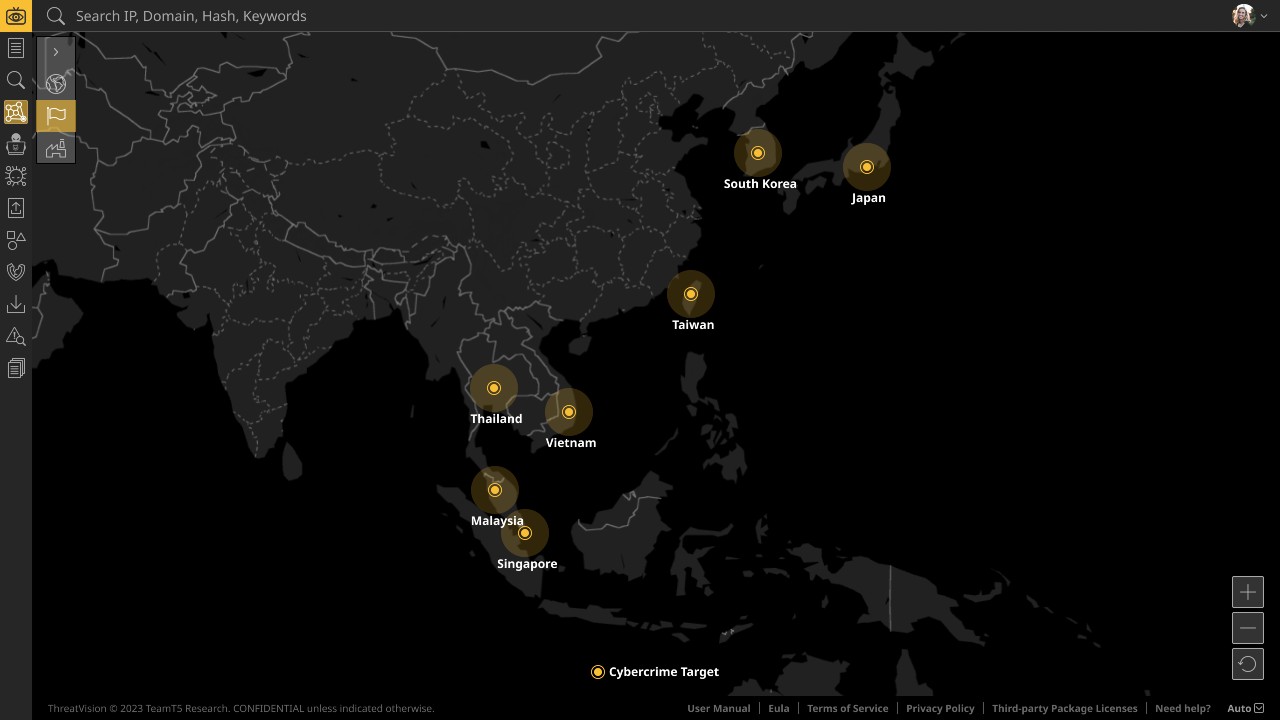
Download the cybercrime intelligence report “Seeing the Adversary: Why APAC Intelligence Matters for CISOs” to understand how insights into attacker motivations and behavior can strengthen your organization’s defensive resilience.
Related Post
ThreatVision Resources
2025.11.24
What Is Cybercrime and How Can Organizations Defend Against It?
ThreatVision, cyber threat intelligence
ThreatVision Resources
2025.11.24
[White paper] Seeing the Pattern Behind The Attacks: APAC Intelligence for CISOs Worldwide
ThreatVision, cyber threat intelligence