Security teams work with many types of security inputs. The harder question is how each one should change what the team does next. For organizations operating in APAC, region-specific threats compound that judgment because the region’s complex geopolitical landscape and sustained activity from multiple state-linked groups create a particularly demanding threat environment.
ThreatVision provides APAC-focused context that helps teams assess those inputs against current regional threat activity. The role of that context changes with the question the team needs to answer.
How ThreatVision supports the next decision
That question differs at each decision moment. Leadership needs to know what deserves management attention, while patch planning depends on evidence that shows which vulnerabilities require earlier action. In SOC and IR workflows, analysts need enough context to validate alerts and define where an investigation should begin. ThreatVision supports these needs by bringing the most relevant intelligence into each decision.
Briefing leadership on priority risk
ThreatVision shows which actors and sectors are most active, then connects those observations with current attack trends. This turns a broad threat update into a management briefing focused on near-term priorities.
Prioritizing vulnerabilities under limited time
The Patch Management Report complements CVSS with TeamT5’s threat-level assessment and confirmation of real-world exploitation. This helps teams distinguish a high score from a vulnerability that requires earlier remediation.
Validating alerts for SOC and IR follow-up
IoCs help analysts compare an alert with known malicious activity. Threat hunting tools and log correlation provide additional evidence, giving SOC and IR teams a clearer basis for deciding whether deeper investigation is warranted. These checks help determine whether an alert requires follow-up and provide a stronger starting point for the initial response.
Building the first investigation hypothesis
When compromise is suspected, ThreatVision helps analysts connect observed behavior with related actors and similar campaigns. That intelligence supports an initial hypothesis about how the intrusion may have unfolded and what it may have affected. The team can then narrow the investigation and make earlier containment decisions.
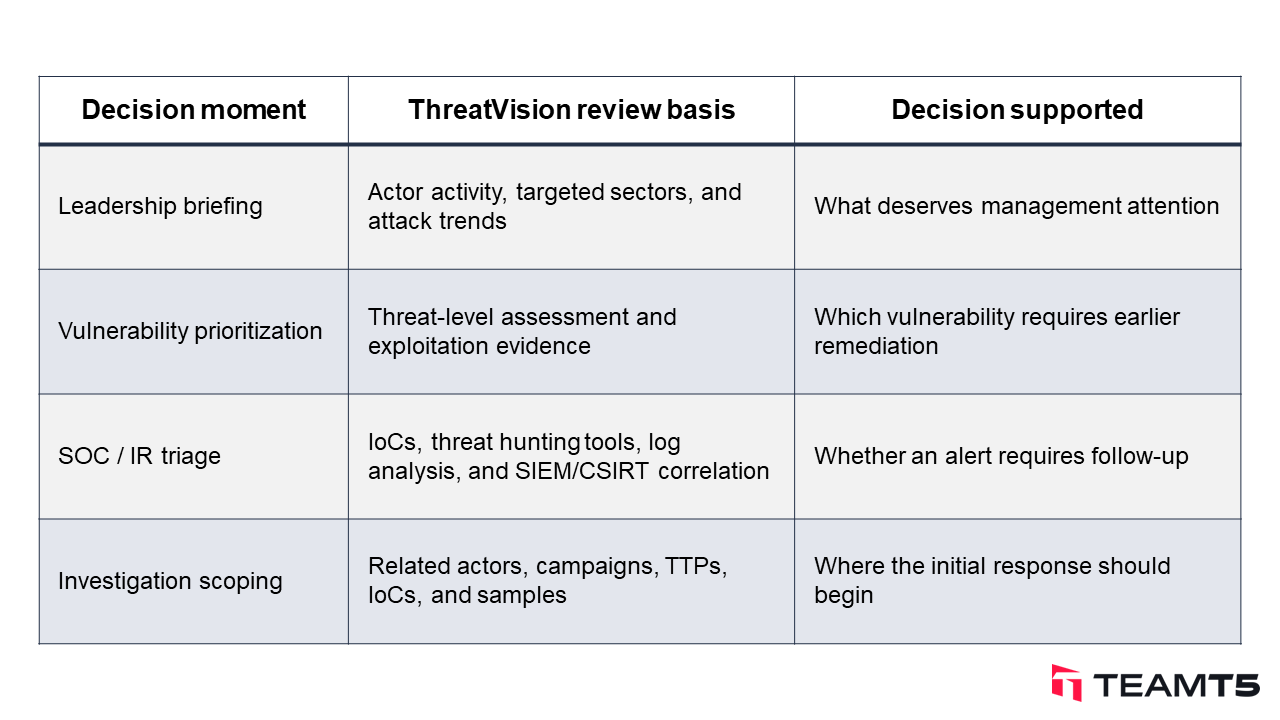
Across the four decision moments, ThreatVision keeps strategic review and operational response aligned to the same current threat picture. Each team can use the information relevant to its decision without losing the connection to broader threat activity. The result is a more consistent path from threat awareness to action.
Contact TeamT5 to request a ThreatVision trial.
Related Post
ThreatVision Resources
2025.11.24
[White paper] Seeing the Pattern Behind The Attacks: APAC Intelligence for CISOs Worldwide
ThreatVision, cyber threat intelligence