Cyber risk is no longer shaped only by isolated vulnerabilities or opportunistic attacks. State-sponsored activity, ransomware operations, exploitation of exposed infrastructure, and abuse of trusted supply chain channels are converging into a more complex threat landscape. This is especially visible across APAC, where critical sectors including government, infrastructure, and IT/technology providers remain recurring targets, while attackers continue to refine their methods to bypass conventional defenses.
For CISOs and security leaders, the challenge is not simply that threats are increasing. The harder question is how to determine which threats are relevant to the organization, which risks require immediate action, and where security investment can most effectively reduce exposure.
Decision barriers in cyber defense
Many organizations already have security tools, vulnerability data, and alerting systems. What they often lack is the attacker context needed to understand the full picture of an attack: why they may be targeted, how attackers are likely to operate, and where the organization may be most exposed.
These barriers usually appear in four ways:
- Ambiguous risk assessment: Without knowing why the organization is being targeted, teams may struggle to evaluate which risks are most relevant.
- Dispersed investment: Without a clear view of truly critical assets, defensive resources may be spread too thin.
- Ineffective initial response: Without understanding attacker methods and behaviors, frontline teams may lose time deciding what to investigate or contain.
- Missed signs: Without monitoring aligned to real attack traces, early signs are easier to miss, increasing the risk of delayed detection and wider impact.
In other words, the issue is not only a lack of information. It is the inability to turn threat context into timely judgment. When that happens, defense remains reactive.
From attack understanding to defensive priorities
To move earlier, organizations need to understand how attackers progress and where defenders can intervene. Intelligence should not be treated as a static list of indicators. Its value comes from helping teams understand how attacks are prepared, delivered, sustained, and eventually turned into business impact.
An attacker-view approach makes defensive action more focused. Intelligence can help leaders reassess exposure when certain sectors or environments are being researched. It can guide security teams toward likely attack paths when specific delivery methods, malware families, or exploited weaknesses appear repeatedly. It can also help SOC teams refine monitoring when command-and-control patterns or related traces are observed. The goal is to make intelligence usable before an incident escalates, not only after damage has occurred.
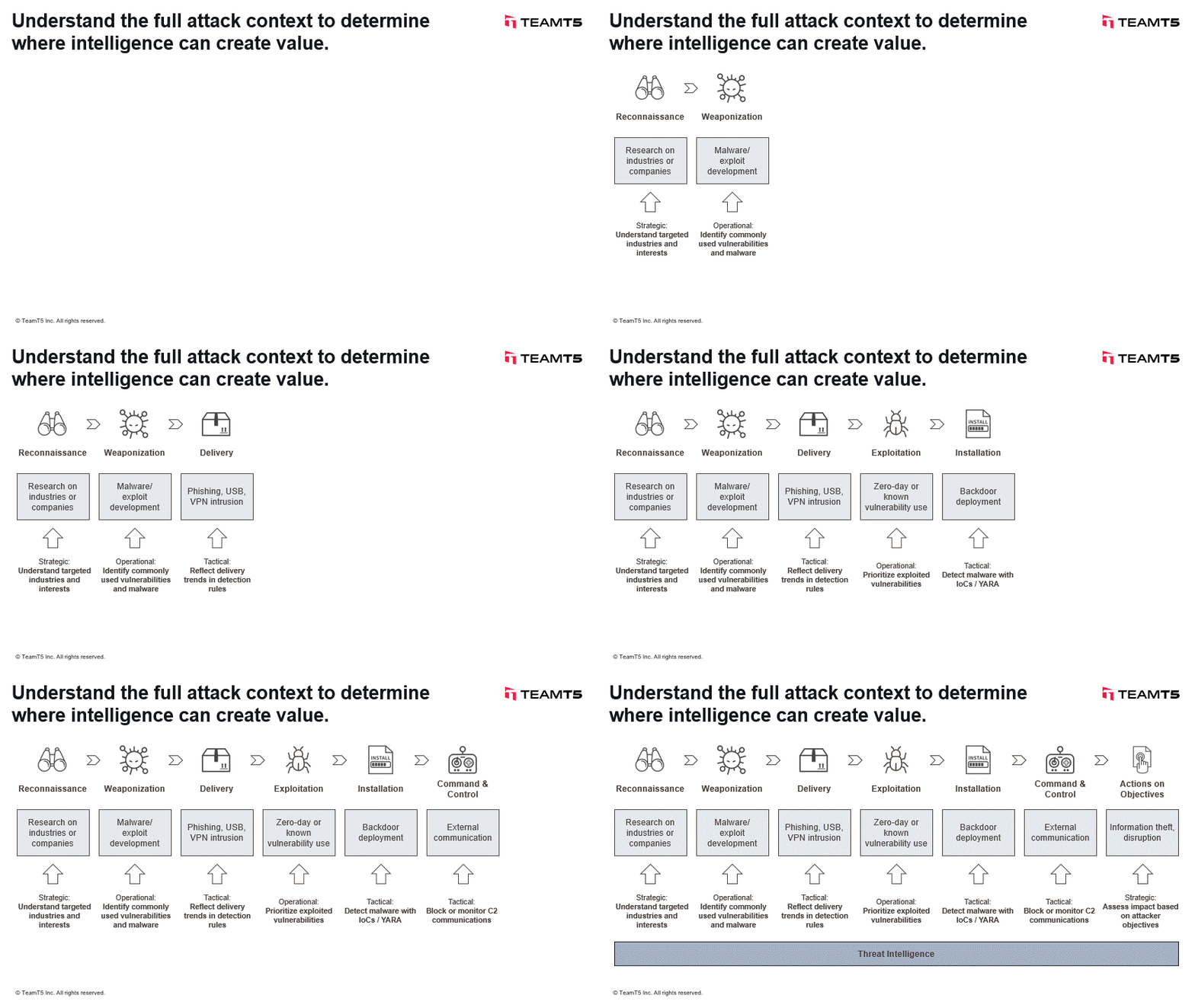
How threat intelligence supports security decisions
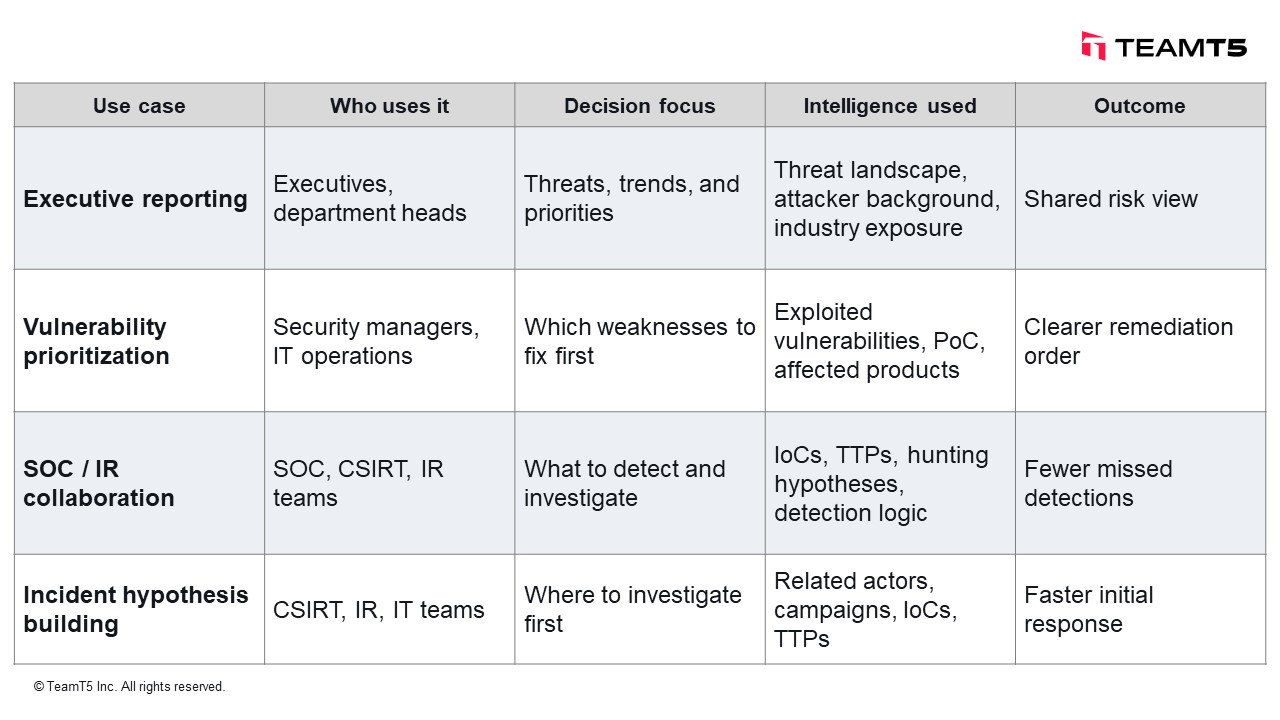
Threat intelligence becomes valuable when it helps teams move from awareness to action. The following use cases show how intelligence supports decisions across different levels of security operations.
1. Executive reporting
Translate geopolitical risk, attacker activity, and sector exposure into leadership-ready priorities for monitoring, investment, and risk planning.
Translate geopolitical risk, attacker activity, and sector exposure into leadership-ready priorities for monitoring, investment, and risk planning.
2. Security improvement and vulnerability prioritization
Go beyond severity scores by using exploitation evidence, threat activity, and business relevance to decide which weaknesses should be addressed first.
Go beyond severity scores by using exploitation evidence, threat activity, and business relevance to decide which weaknesses should be addressed first.
3. SOC and IR enablement
Apply IoCs, TTPs, hunting hypotheses, and detection logic to strengthen SIEM monitoring, improve triage, and support faster initial response.
Apply IoCs, TTPs, hunting hypotheses, and detection logic to strengthen SIEM monitoring, improve triage, and support faster initial response.
4. Incident hypothesis building
Use attacker context and related campaign intelligence to narrow likely intrusion paths, affected scope, and containment priorities during early investigation.
Use attacker context and related campaign intelligence to narrow likely intrusion paths, affected scope, and containment priorities during early investigation.
ThreatVision supports this approach by bringing together threat landscape context, attacker behavior, technical indicators, and monitoring insights into a practical decision foundation. This helps teams turn fragmented intelligence into focused action, from executive reporting and prioritization to detection, investigation, and response.
Focus is the foundation of proactive defense
No organization can respond to every threat with the same level of urgency. Proactive defense starts with focus: knowing which threats are most relevant, which assets require attention, and which actions can reduce risk before the organization is forced into a reactive position. Threat intelligence provides that focus by helping security leaders understand how attackers operate, recognize relevant risks earlier, and direct limited resources toward the decisions that matter most.
Contact TeamT5) to request a ThreatVision trial.
Related Post
ThreatVision Resources
2025.11.24
[White paper] Seeing the Pattern Behind The Attacks: APAC Intelligence for CISOs Worldwide
ThreatVision, cyber threat intelligence